One of the biggest revelations I had early in my time as a writer was that I could write the kind of stories I wanted to read, but didn’t exist. I just had to be the one to bring them into existence. And so I began work on Human & Lupusad: Of Men and Wolves, a fantasy-drama web serial novel set in a newly-industrialized fantasy world divided between two species. And it was a project that proved so successful that I would attempt to reboot it into proper novels.
Many years ago, I borrowed a book from the library. I can’t remember which novel it was, but I definitely remembered the teaser excerpt at the end. In it, an alien mother living in an oppressive interstellar empire had her infant daughter wrenched from her arms and sold into slavery. I didn’t think much of it at the time, but more than a decade later came to regret not tracking down the book given its interesting premise. And yet, hours of Googling later, I found it – The Golden One by Deborah Chester, first novel of the Lucasfilm Alien Chronicles trilogy. I’ll save the full details for a future blog post, but suffice to say I was very eager to track down a copy. The novel and its sequels captured my imagination unlike any book had in a long time, following the epic journey of an alien going from a slave to a rebel figurehead. The mark it left on me was instrumental in developing my interest in writing, and was one of the major influences of Human & Lupusad.
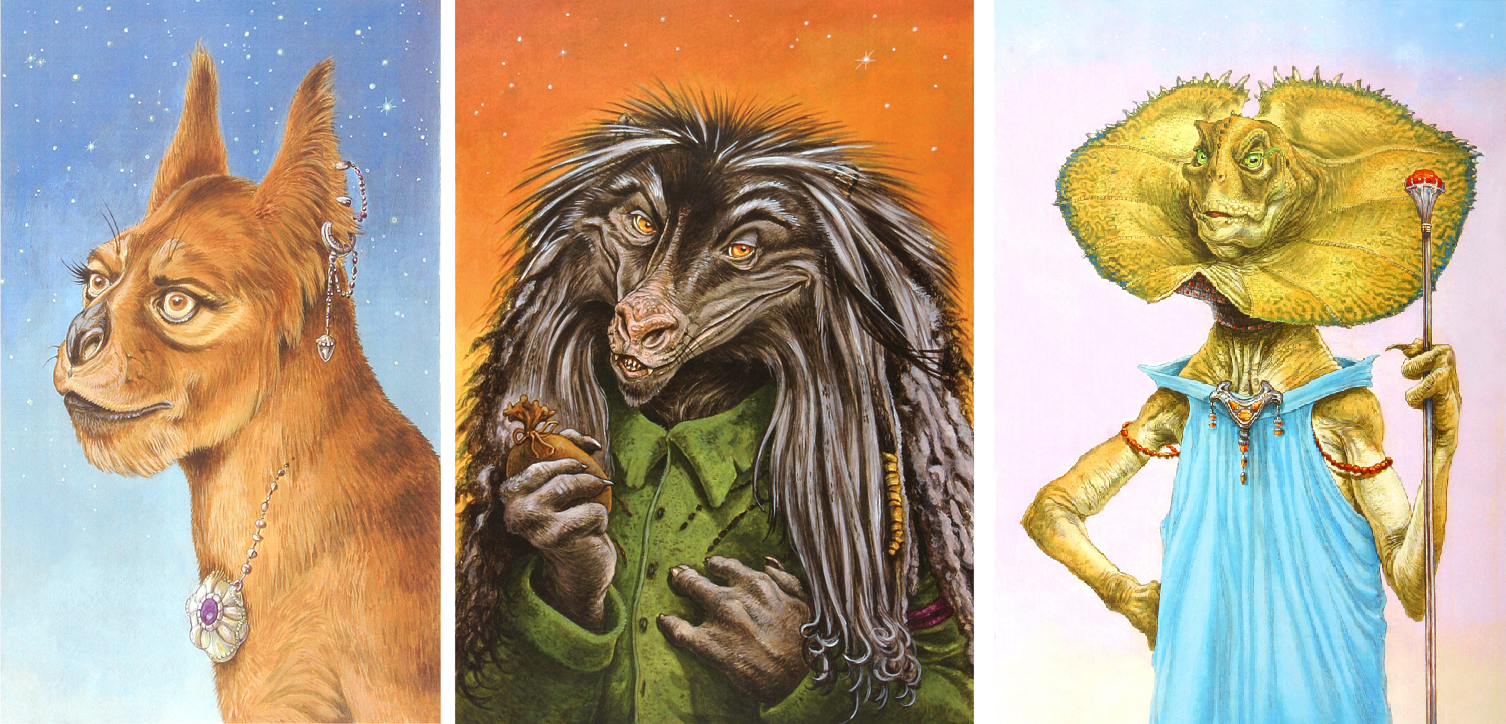 Terryl Whitlatch’s beautiful artwork of Ampris, Elrabin and Israi from the Alien Chronicles, featured on the back covers of The Golden One, The Crimson Claw, and The Crystal Eye respectively. Whitlach’s own thoughts on the portraits can be found here.
But there was one other influence at Human & Lupusad‘s core, and it might seem like a far less literary one at that – Thief, the late-90’s / early-2000’s video game series. Shortly before I discovered Alien Chronicles, a friend of mine picked up a re-release two-pack containing Thief II: The Metal Age and Thief: Deadly Shadows (actually the third game in the series, but the first one released on both consoles and PC). Metal Age flat out did not run on his computer, but I spent hours sitting with him and watching him play Deadly Shadows. The game was utterly fascinating not just mechanically, but artistically. Its setting is a unique blend of Medieval, Renaissance and even Victorian culture and technology, set inside a colossal city-state where thieves are the least dangerous things stalking the shadows. I quickly picked up my own copy, and even managed to install Metal Age while the planets were aligned so that it actually worked. With Metal Age focusing even harder on the Victorian side of the setting, featuring the rise and fall of a steam-powered techno-religion, I quickly developed an interest in the steampunk genre.
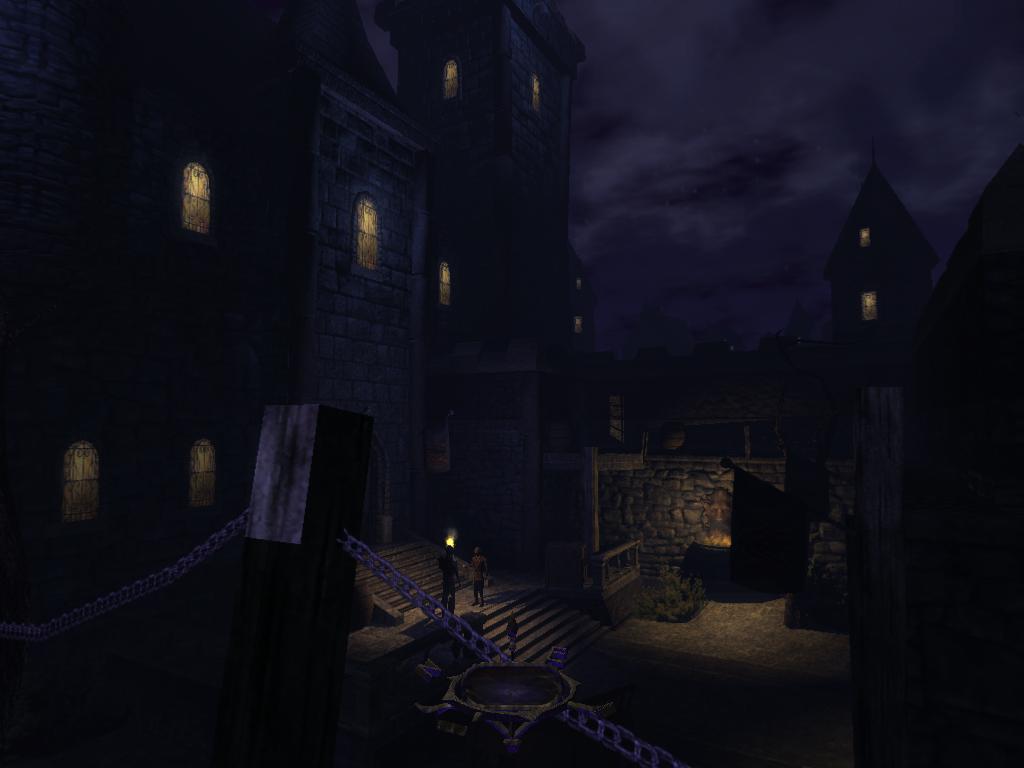 Screenshot from Thief: Deadly Shadows by Eidos Interactive, depicting Rutherford Castle. The two guards by the door hold a conversation on the city’s mysterious history, providing some important foreshadowing of later plot developments in the process.
Is it any surprise, then, that Human & Lupusad is about non-Human slaves living in a Victorian-esque world?
At first, the story was very heavily influenced by Alien Chronicles and Thief, drawing various elements from each. While this did elicit a real passion to write it, I don’t think I spent enough time thinking about the ins and outs of how they’d gel together. The story turned out quite well in the end, but certain elements early on proved glaringly anachronistic as I developed the setting further. Some of the decisions villainous characters make in Alien Chronicles defy common sense even in that series’ setting, and are meant to highlight a society in decline from its own hubris. Emulating these didn’t always translate well to the Victorian setting, with its veneer of propriety. An event shortly before the beginning of the story – in which the home of one of the protagonists is raided by slavers – is a shameless ripoff of the opening of The Golden One, and several readers later noted that it didn’t fit with the world that I had created. It quickly became one of many elements to be ditched in the reboot years later.
Once the story found its footing, though, I was quickly taking it in its own direction instead of relying on its influences so heavily. The story focused on the friendship between a young human aristocrat named Jacob Kingsley and an alchemist named Zayanya. The latter is a member of the titular lupusad, a species of wolf-like people that formed an underclass in human society. They have fur, muzzles, tails and digitigrade legs, but are people just as much as any human. After Zayanya’s father kills a human in self-defense – part of the event mentioned in the previous paragraph – she flees to the port city of Esterton to escape the wrath of the authorities. There she has a chance encounter with Jacob, who takes her under his wing and sets her up with a job at the family manor. As the pair get to know each other, they come to join forces to address the injustices wrought upon the lupusad.
 Screenshots from Thief II: The Metal Age by Looking Glass Studios, depicting the polluted urban sprawl of Dayport contrasted with the officers’ lounge of Shoalsgate Station. The level of stratification seen at some points in the game influenced certain elements of Human & Lupusad.
Why wolves, you ask? I believe they occupy an interesting position in modern culture. On the one hand, they’re still very much a go-to example of a ferocious predator. But at the same time a certain degree romanticism has formed around them. Just check out the mind-boggling selection of wolf-centric t-shirts available around the place. So, I figure that using wolf-people makes them simultaneously an ‘other’ to the people of the setting, laying the foundation for their treatment, but still remaining sympathetic to the reader. Plus, it does make for a fairly novel premise, which is always helpful for standing out from the pack… so to speak.
 Fanart by stumblinbear of Jakob and Zyanya. I changed their names slightly in the reboot; reader feedback showed that quite a few readers had different ways of pronouncing ‘Zyanya’, so I modified it to something a little clearer.
The overall plot of Human & Lupusad was somewhat eclectic, given the lack of fore-planning. Indeed, my original idea for the story was much more modest in scope, focusing on events at a noble estate instead of the wider setting. It wasn’t long before it took on a much more ambitious form. Some elements I had planned out well in advance, such as the the two main characters working to improve conditions for the lupusad and bonding in the process. Others were far more spur-of-the-moment, which varied from serendipitous enhancements to the story to half-baked additions. The most egregious was the final act, which dealt with a lupusad uprising. It became so bloated that it effectively became a built-in sequel. Hell, it even began after a time skip! It was still well-received overall, but there’s plenty of things I intend to improve on. Much of it will likely go towards a future sequel, but more on that later.
A lesson I learned halfway through writing Human & Lupusad was the value of feedback in serialized story and the potential for iterative improvement from it. Partway through, Zayanya returned to her hometown to see what became of her parents. Meanwhile, Jacob remained in Esterton to continue their charity work and face the pressures of high society. Both of them used the opportunity to reflect on their friendship and how it had impacted impacted their lives until that point. All well and good on paper, but it drew on longer than it should have. A few readers eventually noted that they felt the story was at its height when it featured Jacob and Zayanya together and that they were largely waiting for them to reunited. Suffice to say, I made sure to get them back together sooner rather than later. This is another case of the lack of planning rearing its ugly head again, though thankfully easily corrected. Not all of the mistakes I made were handled quite as well.
While the serial nature of web writing can be beneficial for getting immediate feedback, I found that this shouldn’t supercede an author’s own critical sense or confidence in their work. At one point in the story, there’s mention of a scientific paper indicating that lupusad can become near-feral under high levels of stress stress. I originally intended this as a one-off nod to racially-charged pseudoscience used to justify oppression, until one or two people pointed out that it might actually have wider implications for the setting. Panicking at the thought that I had mishandled something, I made further references to it, in doing so realizing that I was undermining the message of acceptance and equality I was setting forth. I ultimately handwaved the matter, and completely excised it from the reboot. But it could have simply been avoided entirely had I been more thoughtful in its original implementation, and taken a more critical eye to reader feedback. Hearing your readers’ thoughts can be immensely valuable, but not all of it is necessarily right for the purposes of the story.
Even so, I found that reader response was one of the most exciting parts of writing. With every new chapter I posted, I eagerly awaited comments from readers new and old alike. Ultimately that came to become a driver for my decision to pursue writing further: telling stories that entertain people and leave an emotional impact. While Human & Lupusad was far from the most successful web serial novel ever released, I was honoured to have several readers make pieces of fanart. A couple felt inspired to write fanfiction about it, and one even analyzed it for an assignment! At that point, I felt like some sort of circle had been complete; just as other writers had inspired me to write, I was now doing the same toward others.
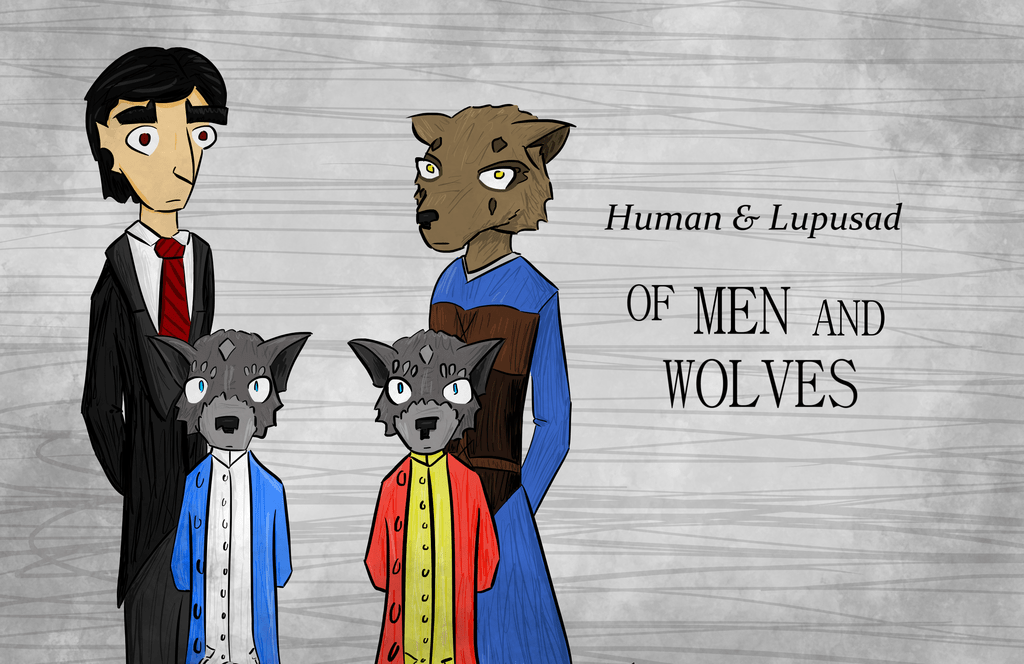
 Cover for the web serial version of Human & Lupusad, kindly created by Vurrunna. The cubs in the picture are Elaiel and Enukr, a pair of street urchins who Jacob and Zayanya come to care for.
Human & Lupusad reached its end in early 2018, about four years after I first started working on it. By that point, it had reached around a quarter of a million words in length, and almost a hundred thousand views over two forums. Despite the imperfect nature of the story, the reception was still very positive. People were genuinely invested in the lives of Jacob, Zayanya and their friends, and were rooting for them to succeed. A number of readers – some being writers themselves – were more than happy to offer feedback. Especially when I was already planning to reboot the stories into a series of novels.
It was also by this point that I was actively studying creative and professional writing, and beginning my journey as a writer and author professionally. Human & Lupusad proved an excellent foundation for this, with the lessons I learned from my time writing the story. And I was able to apply my newer experiences to approach the reboot. A lot more planning went into it, alongside advice from established authors. The new version of the story would look much different, featuring a far more focused and fulfilling story while remaining faithful to the original characters, setting and overall direction. But to ensure no interference between the two, I ultimately took the web serial version down on the first day of 2019. While I kept the original threads intact as a demonstration of the story’s success and to provide updates on the reboot to readers, it was still a bittersweet moment.
I won’t go into too much detail about the reboot. At time of writing, the first book is currently complete, though will likely need a bit of editing before publication. There’s enough raw content left over from the original story to be adapted another book or two, though much of that will likely be even farther removed from its original form. Many elements of those original parts simply do not meet my current standards, and could be implemented much better based on reader feedback as much as my own maturation as a writer. And that’s not even touching new ideas I’ve had since then for all-new plots and sequels. But for now, my focus is on getting the first book published. Being underemployed thanks to the Coronavirus pandemic has left plenty of time to work on Human & Lupusad in its newest form, but not even the publishing industry has been immune to disruption.
I’ll likely revisit this topic in the future, perhaps offering a wider look at web serial writing and offering some generalized on writing it. But until then, I hope you’ve enjoyed reading my reflection, and hope to see you again soon for future posts!
 Alastair Jones - Author